An oil well, a pumping station or an electrical substation in a remote area generates information all the time: pressure, temperature, tank level, valve status and voltage.
The problem isn't that the information doesn't exist, but that without a way to transmit it, it stays on site until someone physically travels there to check it.
A remote asset without telemetry forces decisions based on outdated data
You operate with what was known the last time someone was on site, not with what's happening now. With the right connectivity, sensors and the control center can work as a single system, no matter how isolated the asset is.
SCADA and telemetry, simply explained
Although they work together, SCADA and telemetry play different roles within a remote operation. Understanding that difference shows why connectivity is a critical part of the system.
SCADA
SCADA stands for Supervisory Control and Data Acquisition— the system that makes it possible to supervise and, in many cases, remotely control industrial equipment.
Telemetry
It's the mechanism that carries measurements from the sensors to the control center so the information can be viewed and used for decision-making.
From a control center you can check a compressor's status, supervise a pump or know the position of a valve located hundreds of kilometers away. To do that, the measurement taken in the field must first be able to travel to that system.
Field sensor
Records pressure, level, temperature, status or an alarm.
Telemetry
Carries the data from a remote location.
SCADA system
Receives the information to supervise and act.
The weak point in this process is almost never the sensor. The challenge lies in the connection between the asset and the control center, especially when the infrastructure is located in an area without cellular or fiber coverage, as often happens in oil & gas and energy operations.
Why satellite solves this where the terrestrial network doesn't reach
Many oil fields, gas pipelines, pumping stations and remote substations are located where cellular coverage doesn't exist. It isn't always a temporary carrier outage. In some areas, deploying terrestrial infrastructure simply isn't viable.
Satellite connectivity makes it possible to transport information without depending on cell towers or cabling in the area.
Technologies such as Iridium's short message service, known as SBD or Short Burst Data, are designed to transmit small packets of information, such as a pressure reading, a valve status or an alarm, when there is something relevant to report.
This is especially useful because many SCADA applications don't need to transmit large volumes of information constantly. They need the right data point to arrive reliably when something important changes.
A pressure sensor doesn't necessarily need to report every second if the value stays stable for hours. It does need to quickly report a variation when it crosses a critical threshold.
What can be monitored with satellite telemetry
In oil & gas and energy operations, satellite telemetry can be used to maintain visibility over variables and assets located far from traditional communications infrastructure.
Well and wellhead status and pressure
Compressors and pumping stations
Storage tank levels
Valve status on gas and oil pipelines
Substations and power distribution points
Safety alarms and anomaly detection
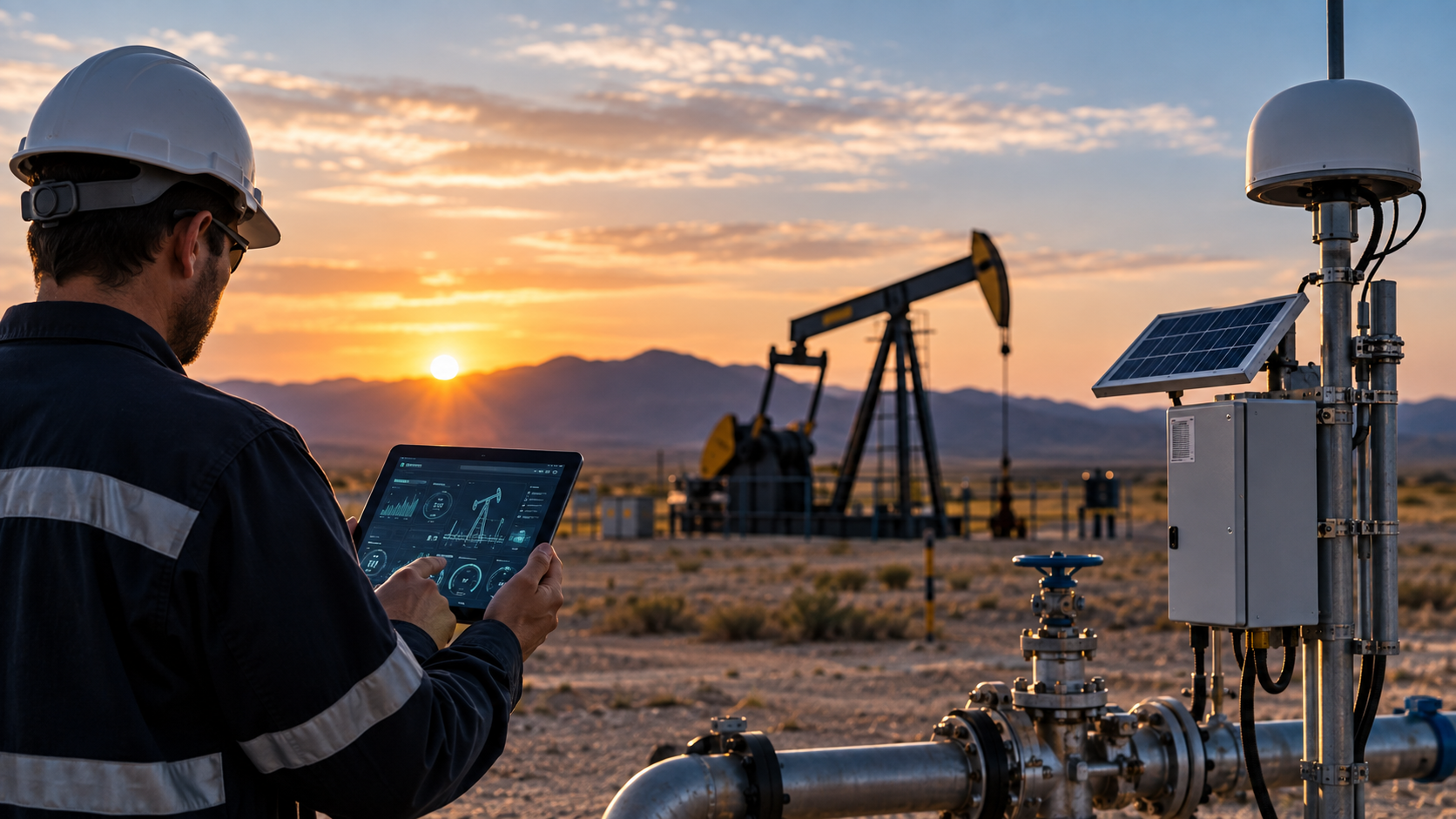
Critical information no longer depends on a physical visit to the asset
Sensors, connectivity and SCADA work as a single architecture to maintain visibility over what happens in the field.
How to design a satellite telemetry system without oversizing it
One of the most common mistakes when designing remote telemetry is trying to transmit everything continuously, as if the asset had fiber optics. This can increase data volume and cost without adding operational value.
The right design starts by identifying what information the operation really needs and when it should be transmitted.
Define which data is truly critical
Determine which variables must be received practically in real time and which can be reported less frequently without affecting the operation.
Design around events, not constant polling
The equipment can report when a value changes significantly or when an alarm is triggered, instead of needlessly sending fixed readings every few seconds.
Define clear thresholds and alarms
The system must distinguish between a normal process variation and a condition that requires immediate attention.
Integrate telemetry with the existing SCADA system
Data should arrive at the same control center where the other assets are already supervised, avoiding yet another isolated platform.
How ECOMIL approaches it
At ECOMIL we design satellite telemetry solutions for remote oil & gas and energy assets, using Iridium connectivity to carry data from sensors and control systems from locations without terrestrial coverage.
The work starts by defining with the client which information is critical, how often it should be reported and how it should be integrated with the SCADA system the operation already uses, rather than imposing a generic connectivity architecture.
- Identification of critical variables
- Definition of frequency, events and alarms
- Satellite connectivity design
- Integration with the existing SCADA architecture
What it looks like in practice
An operation with several wells scattered across an area without cellular coverage may depend on periodic visits to check the status of each asset. This creates the risk that a leak, a pressure drop or an equipment failure goes unnoticed for hours or even days.
By adding satellite telemetry, each well can automatically report its status and trigger an alarm when a variable goes outside the defined parameters, without anyone having to travel to the site just to find out what's happening.
Critical information must arrive when it really matters
Satellite telemetry isn't about turning a remote field into an office with fiber optics. Its goal is to get critical information to the control center when it really matters, without depending on terrestrial infrastructure that will probably never be available at that location.
Well designed, it brings scattered, isolated assets into a system that can be supervised and operated in a coordinated way.
Does your operation make decisions with real-time data or with what was known the last time someone visited the site?