
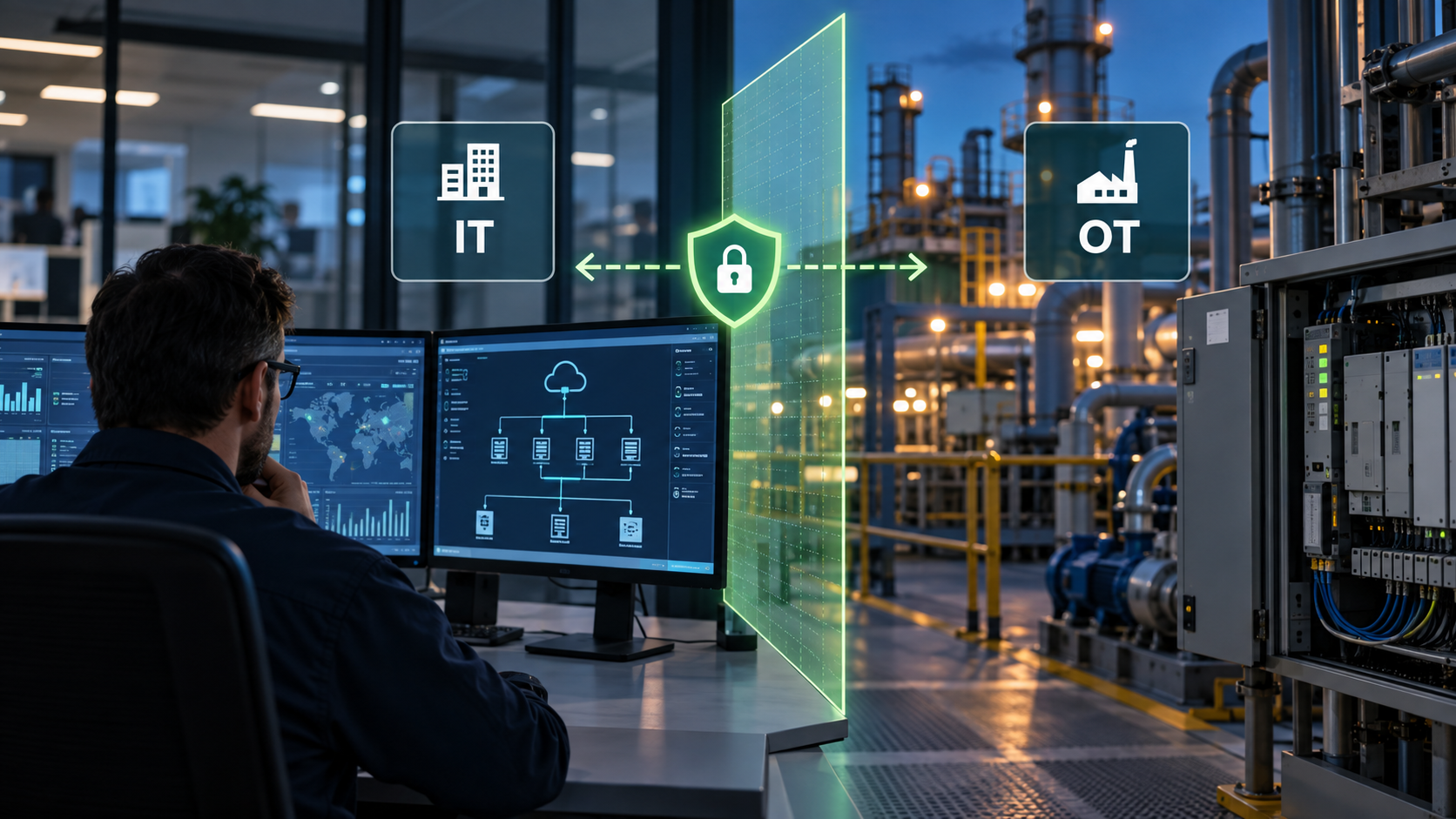
For years, office systems and the systems that control the plant or the field worked in separate worlds, with very little communication between them.
Today that has changed. Companies want to view production data in their management systems, implement predictive maintenance and monitor remote assets from a single environment. Connecting IT and OT creates real value.
Connecting IT and OT expands the potential impact of an incident
A phishing email that compromises an office computer no longer necessarily stays in the office. Without proper separation, that access can move on to systems that control a pump, a compressor or a production line.
Segmenting doesn't mean disconnecting everything again. It means sharing exactly what the operation needs, without exposing the rest of the infrastructure.
Why IT and OT shouldn't be treated the same
IT and OT are part of the same organization, but their priorities, risks and operational needs are different.
Information Technology
Includes business systems such as email, ERP, files and corporate applications. These environments are exposed to the Internet, external users and the everyday traffic of a modern company.
Operational Technology
Includes sensors, PLCs, SCADA systems, valves, pumps and production lines that control physical processes within an industrial operation.
An incident can affect information and services
The goal is usually to recover systems, protect information and restore corporate services.
An incident can affect a physical process
A failure can mean stopped production, risks to staff or damage to industrial equipment.
Treating both networks with the same security criteria is one of the underlying mistakes. A software patch that can be applied quickly in IT may require a scheduled maintenance window in OT, because interrupting a control system at the wrong moment can have significant operational consequences.
What the data says about this risk
According to figures reported by Kaspersky, more than 40% of industrial OT systems were targeted by a cyberattack in the past year. The industry landscape also shows a shift toward incidents whose impact can go beyond information theft and directly affect operations.
This reinforces an important reality: IT/OT segmentation is no longer just a topic for automation teams. It is also a business continuity decision.
The standard that already addresses this problem: IEC 62443
There's no need to invent an approach from scratch. IEC 62443 provides an international framework for the security of industrial automation and control systems and applies the principle of separating assets according to their security needs.
Assets with common security requirements
A zone groups assets that share risk characteristics and security requirements, such as the controllers associated with the same part of the industrial process.
Controlled communication between zones
A conduit defines the authorized communication between different zones and establishes where information can flow in a controlled way.
From business systems to the physical process
The core idea is simple: information can flow from OT to IT in a controlled way, while access from IT to control systems must pass through defined, limited security points.
How to apply segmentation without slowing production
Segmenting correctly doesn't mean isolating the plant from the rest of the company. It means deliberately designing what information is shared, between which systems it can flow and through which path.
Inventory and classify assets
Before segmenting, you need to know what exists on the OT network, including controllers, sensors, supervisory systems and other assets, and determine how critical each one is.
Define zones based on real criticality
Assets should be grouped according to their security requirements and the impact an incident would have, not just according to how they are currently connected.
Establish specific conduits
An engineer who needs to check production data from the corporate network doesn't need open access to the entire OT infrastructure. They only need the communication required to do their job.
Implement industrial firewalls and a DMZ
Communication between IT and OT must pass through controlled intermediate points to avoid direct connections from corporate systems to industrial controllers.
Actively monitor traffic between zones
Segmentation must be maintained and supervised. A misconfigured conduit can, over time, become an access path the organization never intended to enable.
Why this matters in industry, energy and oil & gas
In industrial environments, an incident on the OT network can have consequences that go far beyond information loss.
Industry
An outage can stop production lines and affect critical processes.
Power
Control system availability is essential to maintain service continuity.
Oil & gas
OT systems control assets where a failure can affect production, equipment and operational safety.
So the question isn't whether connecting IT and OT adds value. Visibility and efficiency justify that integration. The right question is how to do it without turning that connection into an open path to the systems that keep the operation running.
How ECOMIL approaches it
At ECOMIL we assess the current architecture of the operation's IT and OT networks to identify open connections, unnecessary routes and points where the control infrastructure may be exposed to risks coming from the corporate network.
Based on this analysis, we design segmentation following the IEC 62443 zones and conduits approach, adding the control points needed so production data keeps reaching business systems without exposing control systems to the same level of risk as an office network.
- Assessment of the existing IT and OT architecture
- Identification of connections and unnecessary exposure
- Zone design based on criticality
- Definition of conduits and control points
- Integration without affecting operational continuity
Connecting IT and OT isn't the problem
The risk appears when that integration is done without a clear segmentation architecture. With a zones and conduits approach, it's possible to share exactly the information the operation needs while keeping control systems separate from the usual exposure level of a corporate network.
Does your industrial network have real segmentation between IT and OT today, or is everything connected without clear control points?