

In oil & gas, mining or government operations with a presence in remote areas, connectivity isn't an office service but an essential part of the operation.
Sensors, control systems, video surveillance and real-time reporting stop working if the only link connecting the site to the rest of the organization goes down.
When a site is critical, relying on a single link turns any outage into an operational shutdown
Resilience isn't achieved by buying a bit more bandwidth. It's achieved by designing the right network architecture from the start.
What hybrid connectivity is and what it isn't
Hybrid connectivity combines two or more different connection technologies, for example fiber or radio link as the primary link and satellite as the alternate link. They all run under a single system that manages them intelligently, instead of operating as separate networks that nobody coordinates.
Technology diversity managed as a single network
Links are monitored, prioritized and respond in a coordinated way when connection quality changes.
Two providers connected without a common strategy
Having two contracts doesn't guarantee resilience if both links share the same infrastructure or depend on manual intervention.
Two fiber links from different providers may run along the same pole or right-of-way. A single excavator could cut both at the same time. A satellite link, on the other hand, doesn't share physical infrastructure with fiber or radio links. That's why it provides a truly independent path for backup in a hybrid architecture.
The three pieces of the architecture
Designing hybrid connectivity that works during a failure requires three components working together, not just more than one cable.
Truly diverse links
The primary and alternate links must rely on physically different infrastructure. A terrestrial plus satellite combination prevents a single local failure from affecting both.
Automatic switchover
A failover or SD-WAN system monitors link quality and moves traffic to the alternate link within seconds when the primary degrades or stops working.
Priority for critical traffic
Control systems, sensors and safety communications must keep priority when the site runs on more limited backup capacity.
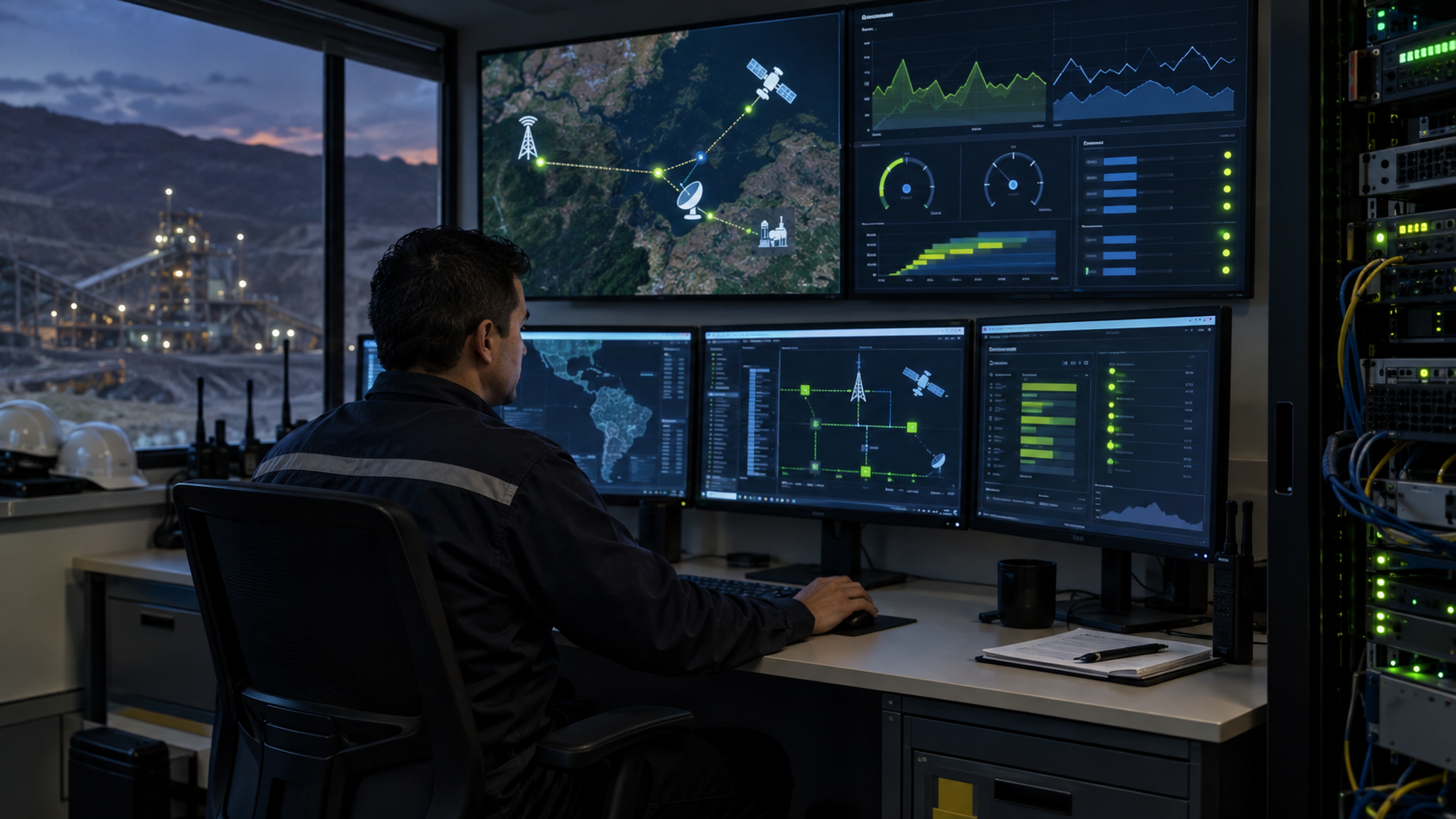
The network must act before the failure becomes an outage
Failover and load balancing
Redundancy can be used in two ways. Although both approaches protect continuity, they don't work the same way or use the links in the same way.
Failover
The alternate link remains available and kicks in when the primary fails. It's the simplest approach, although it leaves the second link unused during normal operation.
Load balancing
Both links work at the same time and share the traffic. If one fails, the other keeps running and absorbs the additional load, making better use of the investment.
For a truly critical site, the ideal is to combine both approaches: balance traffic under normal conditions and reserve enough capacity so each link can sustain essential systems if the other fails.
How it's designed, step by step
Classify the site's criticality
A secondary warehouse doesn't need the same level of resilience as a production platform or a control center. Design starts by understanding the real impact of an outage.
Identify the available technologies
Fiber, radio link, 4G, 5G and satellite are rarely all available at the same time. The architecture must start from what can actually be installed and sustained in the area.
Choose an independent combination
The primary and alternate links shouldn't share the same physical medium or depend on the same last-mile provider.
Define switchover and priority rules
Establish how quickly the system should switch links and which applications keep priority when available capacity drops.
Test switchover on purpose
The primary link must be deliberately shut down to verify the full response. A backup architecture that is never tested is still just an assumption.
Why it's especially important in oil & gas, mining and government
These sectors share a characteristic that makes hybrid connectivity critical: their remote sites aren't optional.
These operations can't be moved to an area with better coverage. That's why resilience must be built around the real location, not an ideal one.
How ECOMIL approaches it
At ECOMIL we design hybrid connectivity architectures that integrate terrestrial links, such as fiber, radio link, 4G and 5G, with satellite connectivity as the foundation for true independence.
The solution includes traffic switchover and prioritization systems so the network responds automatically to a failure, without depending on someone reacting in time. The design always starts from the criticality of each site, not from a generic template applied to the entire operation.
- Criticality analysis by site and service
- Selection of truly independent links
- Switchover and prioritization design
- Failure testing, monitoring and continuous improvement
Resilience doesn't come from just any second link
A well-designed hybrid architecture lets a remote site keep operating when one of its links fails. For oil & gas, mining and government operations, where location isn't negotiable, that architecture is what separates a minor failure from a complete operational shutdown.