
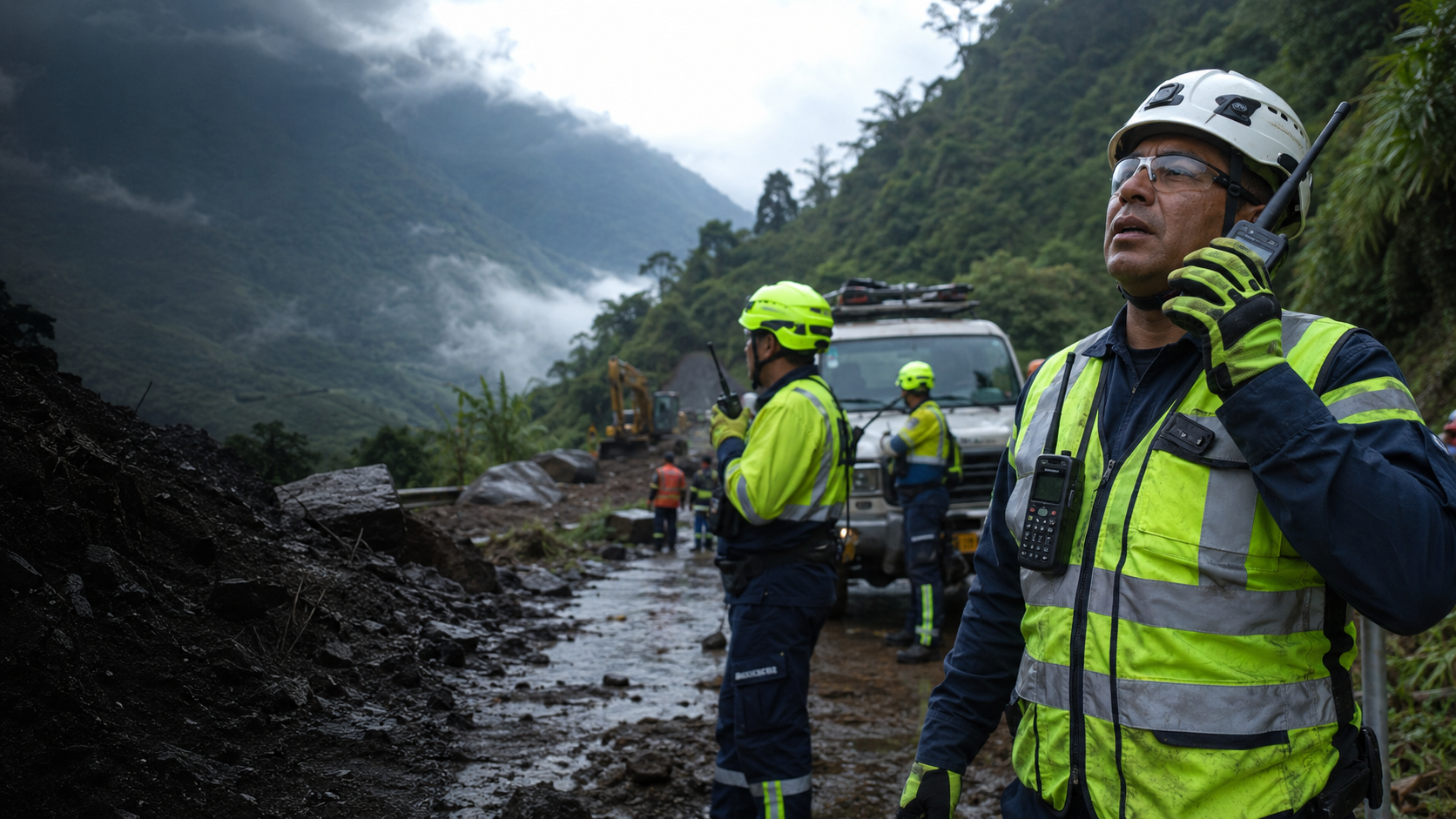
When a brigade arrives at a landslide, a flood or a disaster area, it almost always carries a radio. It remains an essential tool because it lets the team coordinate while working on the ground.
The problem arises when the organization assumes that radio covers all the communications the operation needs. It can connect brigade members to each other, but not necessarily the team to a hospital, a regional coordination center or the external resources that must be mobilized.
The radio lets you talk inward. The satellite phone lets you report and request support outward.
What radio does well and what it can't do.
Radio is fast, simple and effective for giving immediate instructions without interrupting the work. That's why it remains the backbone of brigades' internal communication. Its limits, however, become critical when the event goes beyond the local area or affects the supporting infrastructure.
Where radio is strong
Immediate coordination, short messages and operational communication between people working within the same network and coverage area.
Three limits that matter
- Terrain determines range. Mountains, collapsed structures, tunnels and distance can block or weaken the signal.
- Wide coverage may depend on repeaters. That infrastructure may be damaged or left without power during the same disaster.
- It operates within a defined network. On its own, it doesn't replace an external call to the hospital or the coordination center.
This isn't a flaw in the radio. It's simply the result of being designed mainly for operational communication within the team. The gap appears when it's also expected to connect the brigade with external organizations.
What the satellite phone solves.
A satellite phone doesn't need a nearby cell tower to establish communication. With active service and a clear view of the sky, it can provide a channel independent of local terrestrial infrastructure.
Alert the hospital
Makes it possible to coordinate the reception of the injured and share information before transport begins, depending on the service plan.
Report to command
Connects the field team with the center where decisions are made and additional resources are allocated.
Request more help
Makes it easier to request evacuation, reinforcements or logistical support without waiting for someone to find cellular coverage.
Some satellite terminals and services also allow sharing coordinates or activating tracking functions. That capability depends on the model, network and plan, so it must be validated when designing the solution.
Important: satellite telephony requires a clear sky, available battery, an active plan and periodic testing. It shouldn't be stored away as equipment “for someday”; it must be built into the protocol, assigned to owners and tested before an emergency.
It's not about replacing the radio: it's about completing what it lacks.
The right question isn't “radio or satellite phone.” Each technology solves a different layer of communication, and together they make for a more complete operation.
A brigade can coordinate perfectly among its members and still be cut off from the rest of the response system if terrestrial networks fail. The satellite phone covers exactly that link to the outside.
The context in Colombia.
Institutional coordination needs networks capable of connecting the field with decision centers.
Law 1523 of 2012 adopted Colombia's national disaster risk management policy and established the National Disaster Risk Management System. Later, Decree 2434 of 2015 created the National Emergency Telecommunications System as part of that framework.
This context recognizes telecommunications as a core capability for facilitating, supporting and strengthening risk management processes. For a brigade, that means being able to report to external coordination levels, in addition to talking within its own team.
What it looks like in practice.
A brigade arrives to respond to a landslide on a rural road. The event blocked the road, left people injured and affected the communications infrastructure available in the area.
The radio organizes the local rescue
Members split up tasks, locate the injured and coordinate safe movement within the landslide area.
Terrestrial communication is unavailable
There's no cellular coverage, and the repeaters that provided extended range are out of service or without power.
The satellite phone connects with the outside
The brigade alerts the hospital, reports the number of injured and requests additional resources from the site, without having to move to a place with signal.
How ECOMIL helps.
At ECOMIL we provide satellite telephony solutions for emergency response brigades and risk management organizations, designed to complement — not replace — the radio communication they already use.
The solution is sized according to the brigade's size, the territory, the risks and the external entities it must coordinate with.
- Assessment of coverage, terrain and emergency scenarios.
- Definition of equipment, services and owners.
- A clear protocol: what goes over radio and what goes over satellite.
- Periodic testing, training and operational verification.
Before the rescue, communication must be complete.
Internal coordination
External connection
The radio connects the brigade with itself. The satellite phone connects it with the hospital, the coordination center and the help that's on its way. The goal isn't to choose one: it's to make sure the team can talk both inward and outward, even when local infrastructure fails.